
Why Your AI Language Tutor Should Interrupt You More: The Case for Real-Time Correction in Speaking Practice
Last updated on
Editorial owner: Kier Lee Zamora · Editorial policy
Most language learners think a “good” conversation partner is patient, encouraging, and willing to let them finish every sentence.
That sounds nice. It is also one reason speaking mistakes become fossilized.
If you always receive feedback after the conversation, you may understand the correction intellectually, but your mouth has already practiced the wrong pattern five more times. Real-time correction changes that. It catches the error while your brain is still building the sentence, when the habit is still soft enough to reshape.
Here is the uncomfortable idea: your AI language tutor should probably interrupt you more often, not less. Not constantly. Not rudely. But at the right moments, with the right kind of correction, before small mistakes become your “normal” way of speaking.
And near the end, we will get to the practical part most learners miss: a simple setting-style framework for deciding when your tutor should interrupt you, when it should wait, and when it should let the mistake go completely.
Why “Let Me Finish” Can Be Bad for Speaking Practice
In real conversations, interruption can feel impolite. In language practice, it can be a gift.
The problem is not making mistakes. Mistakes are essential. The problem is repeating the same mistake so often that it starts to feel correct. This is especially common with pronunciation, verb endings, word order, and “almost right” phrases that people understand but native speakers would not naturally say.
The delayed feedback trap
Delayed feedback often sounds helpful:
- “You made three grammar mistakes.”
- “Your pronunciation of world was unclear.”
- “Try to use the past tense more consistently.”
But after a five-minute conversation, can you remember the exact moment you said the sentence? Can you reproduce the mouth position you used? Can you feel the difference between the wrong version and the better version?
Often, no.
This is why many learners can understand corrections but still cannot use them in speech. It is closely related to the output gap: the frustrating distance between recognizing a language and producing it under pressure. Talkio has covered that problem in detail in why you can read a language but still cannot speak it.
Real-time correction makes the error visible
Real-time correction works because it interrupts the pattern at the point of use. Instead of hearing “you had some tense issues,” you hear:
- You said: “Yesterday I go to the office.”
- Try: “Yesterday I went to the office.”
- Now repeat: “Yesterday I went to the office.”
That tiny sequence matters. It connects the correction to the exact sentence, the exact intention, and the exact speaking moment.
The Three Kinds of Interruptions an AI Tutor Should Use
Not all interruptions are useful. A tutor that stops you every three seconds will destroy your confidence and fluency. A tutor that never stops you may protect your feelings while quietly protecting your mistakes.
The best real-time speaking feedback uses different interruption types for different learning goals.
1. Pronunciation interruption
This is useful when one sound changes meaning or makes the word hard to understand.
Examples:
- ship vs. sheep
- rice vs. lice
- three vs. tree
- beach vs. a much riskier mispronunciation
A good AI tutor should not simply say “wrong pronunciation.” It should isolate the sound, model it, and ask you to retry in context.
Mini drill:
- Say: “I saw three trees.”
- Repeat only the difficult sound: “th, th, three.”
- Contrast it: “tree, three, tree, three.”
- Use it in a new sentence: “Three people are waiting.”
For a deeper look at sound contrasts, see Talkio’s guide to minimal pairs like ship vs. sheep and the article on training the English “th” sounds.
2. Grammar interruption
Grammar interruption is useful when the mistake affects the structure you are actively trying to build.
For example, if today’s lesson is past-tense storytelling, your tutor should interrupt sentences like:
- “Last weekend I go hiking.”
- “She buy a new phone yesterday.”
- “We was very tired.”
But if the lesson is small talk fluency, the tutor may not need to stop every article mistake. “I went to store” is worth correcting eventually, but interrupting every missing “the” can make the conversation collapse.
3. Communication interruption
This is the most underrated type. Sometimes the sentence is grammatically possible but socially odd, too direct, too vague, or not what a speaker would normally say.
Examples:
| What the learner says | Why it may sound odd | More natural option |
|---|---|---|
| “Give me your report.” | Too direct in many workplace contexts | “Could you send me the report when you have a moment?” |
| “I want coffee.” | Correct, but abrupt in service situations | “Could I have a coffee, please?” |
| “Explain me this.” | Common transfer error | “Could you explain this to me?” |
This is where AI speaking practice can become much more than pronunciation scoring. It can help you choose language that fits the situation. Talkio has explored this in why direct phrases can sound rude in English but normal in other languages.

What Research Suggests About Immediate Feedback
Language teachers have debated correction for decades: Should learners be corrected immediately, later, explicitly, indirectly, frequently, or only when meaning breaks down?
The honest answer is that correction works best when it is specific, timely, and matched to the learner’s level. Research on second-language acquisition often discusses “corrective feedback,” including prompts, recasts, clarification requests, and explicit correction. You can explore academic work on this topic through databases such as ERIC and Google Scholar.
Immediate correction is powerful when attention is available
If you are struggling to form a sentence at all, constant interruption can overload you. But if you are able to communicate and keep repeating a specific error, immediate feedback can be very effective because your attention is already on the form.
Think of it like a music teacher stopping you on the exact wrong note. Annoying? Maybe. Useful? Usually.
Not every mistake deserves the same response
A strong AI tutor should understand the difference between:
- Errors that block meaning: “I borrowed him money” when you mean “I lent him money.”
- Errors that damage clarity: saying “sheet” with the wrong vowel.
- Errors that are noticeable but not urgent: missing an article in a sentence people still understand.
- Errors outside today’s goal: a tiny preposition mistake during a fluency drill.
This is also why measuring real speaking level is more complex than counting streaks or completed lessons. A learner may have a perfect app habit and still struggle with spontaneous production. For more on that, read why streaks do not measure real speaking level.
The Best Moments for an AI Tutor to Interrupt You
The question is not “Should AI correct me?” The better question is “When should AI correct me?”
Here are the moments when interruption is usually worth it.
When the mistake changes the meaning
If you say “I am boring” when you mean “I am bored,” your tutor should stop you. That is not a tiny grammar issue. It changes what you are saying about yourself.
More examples:
- “I passed an exam” vs. “I took an exam.”
- “I know him last year” vs. “I met him last year.”
- “She is funny” vs. “She is fun.”
When you repeat the same mistake three times
One mistake can be a slip. Three repetitions are a pattern.
If you keep saying “people is,” “he go,” or “I am agree,” the tutor should interrupt and build a quick correction loop:
- Stop the conversation briefly.
- Show the repeated pattern.
- Give the corrected form.
- Ask for three fast repetitions.
- Return to the conversation immediately.
When pronunciation blocks understanding
If a human listener would probably ask “Sorry, what?” your AI tutor should not politely pretend everything is fine.
This matters because many learners do not know which pronunciation issues are actually important. Some accent features are harmless. Others cause confusion. Talkio’s article on whether your accent can affect communication and perception explains why the goal is not sounding native, but being clear.
When the learner asks for strict mode
Some days you want conversation flow. Other days you want a tough coach. An AI tutor should let you choose.
Useful learner commands include:
- “Interrupt me for pronunciation only.”
- “Correct every past tense mistake.”
- “Let me speak for two minutes, then summarize my top three errors.”
- “Stop me if I sound too direct or unnatural.”
- “Focus only on word order today.”
When Your AI Tutor Should Not Interrupt You
Here is the provocative part with a necessary warning: more interruption is not always better. Bad correction can train hesitation.
If a tutor interrupts at the wrong time, you may start speaking in tiny, nervous fragments just to avoid mistakes. That is the opposite of fluency.
During fluency sprints
A fluency sprint is a short period where the goal is continuous speech, not perfect speech.
Try this:
- Choose a simple topic: “Describe your morning.”
- Speak for 60 seconds without stopping.
- Tell the tutor: “Do not interrupt unless meaning breaks down.”
- Afterward, ask for the top two corrections only.
- Repeat the same topic with the corrections included.
This keeps fluency and accuracy connected instead of turning them into enemies.
When the learner is a true beginner
Beginners need correction, but they also need momentum. If someone can barely produce a sentence, interrupting every error is like correcting someone’s running form before they can stand up.
At beginner level, the tutor should prioritize:
- Survival phrases
- Basic pronunciation that affects meaning
- High-frequency verbs
- Confidence with short answers
- Simple question-and-answer patterns
As the learner improves, correction can become more precise. This matches the broader trend toward adaptive AI conversation practice, discussed in how AI can adapt to beginner speakers.
When the correction is not actionable
“Your intonation is unnatural” is not enough.
A useful correction should answer three questions:
- What exactly did I do?
- What should I do instead?
- How can I practice it right now?
For example:
Weak feedback: “Your rhythm sounds unnatural.”
Better feedback: “You stressed every word equally. In this sentence, stress need and Friday: ‘I need it by Friday.’ Repeat it three times with those two words stronger.”
A Practical Correction Framework: Stop, Nudge, Save, or Ignore
This is the reveal promised earlier: you do not need one correction style. You need four.
When practicing with an AI language tutor, use this framework to decide how interruptions should work.
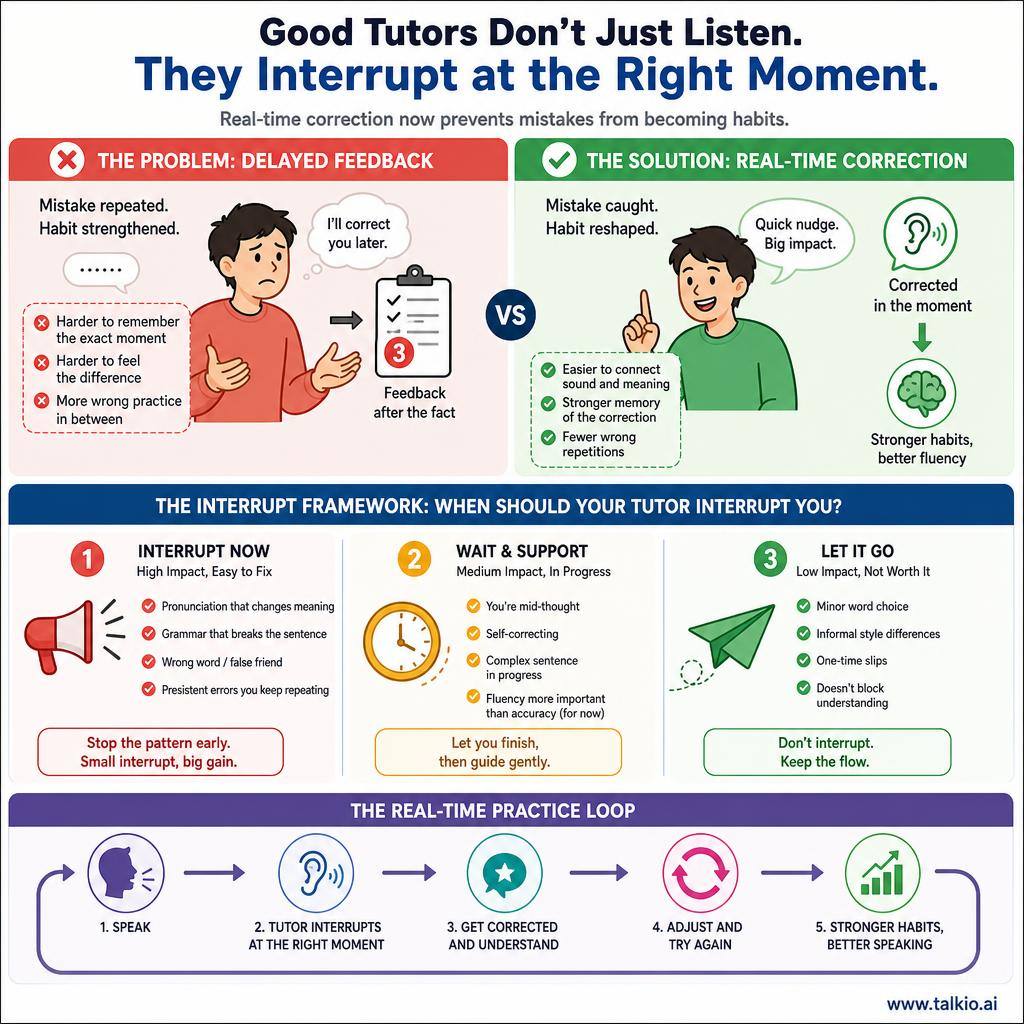
1. Stop: interrupt immediately
Use this for serious errors that affect meaning, pronunciation, or the target skill of the session.
Prompt to use: “Stop me immediately if I make a mistake with today’s focus: past tense storytelling.”
Good for:
- Pronunciation contrasts
- Exam speaking criteria
- Job interview practice
- High-stakes presentations
- Repeated grammar patterns
2. Nudge: correct lightly without stopping the flow
A nudge is a quick recast. You say the sentence incorrectly, and the tutor responds naturally with the corrected form.
Example:
- You: “Yesterday I go to my friend’s house.”
- Tutor: “Oh, you went to your friend’s house yesterday. What did you do there?”
This keeps the conversation alive while still feeding your brain the correct version.
3. Save: collect errors for later
Use this during fluency practice, storytelling, or role-play. The tutor lets you speak, then gives a short error report.
Prompt to use: “Let me speak for three minutes. Save my errors and give me only the five most important corrections afterward.”
This is especially useful for learners who freeze when corrected too often. Talkio has written more about the emotional side of this in how to practice mistakes without fear.
4. Ignore: let small errors pass
Yes, sometimes the best correction is no correction.
If the learner is communicating clearly, building confidence, and working on a different target, the tutor can ignore low-priority errors temporarily. This is not lowering standards. It is sequencing attention.
For example, during a travel role-play, it may be more useful to practice handling unexpected questions than to stop for every article mistake. You can return to grammar later.
Real-Time Correction Drills You Can Try Today
Here are practical drills you can use with an AI tutor, a teacher, or a very patient conversation partner.
Drill 1: The three-strike pattern hunt
Best for grammar habits you keep repeating.
- Choose a conversation topic: work, travel, hobbies, school, or food.
- Tell the tutor: “Listen for repeated mistakes. Do not stop me until I make the same type of mistake three times.”
- Speak for three to five minutes.
- When the tutor stops you, ask for the pattern, not just the individual sentence.
- Create five new sentences using the corrected pattern.
Example correction:
- Pattern: You are dropping third-person -s.
- Your sentences: “She work,” “He live,” “My brother play.”
- Correct pattern: “She works,” “He lives,” “My brother plays.”
Drill 2: Pronunciation pause-and-retry
Best for sounds that affect clarity.
Prompt: “Interrupt me only when my pronunciation could cause misunderstanding. Give me a minimal pair and make me repeat the sentence.”
Practice set:
- “I need a sheet of paper.”
- “The road is very wide.”
- “Can you hear the fan?”
- “I will leave at six.”
Drill 3: Politeness repair role-play
Best for workplace English, customer service, interviews, and travel.
Prompt: “Role-play a workplace conversation. Interrupt me if my sentence is grammatically correct but too direct, vague, or unnatural.”
Try repairing these:
| Too blunt | More natural |
|---|---|
| “Send it now.” | “Could you send it when you get a chance?” |
| “I don’t understand your email.” | “Could you clarify what you meant in your email?” |
| “Your idea is wrong.” | “I see it a bit differently. Could we look at another option?” |
Drill 4: Exam-style interruption mode
Best for IELTS, TOEFL, and other speaking tests where timing and structure matter.
Prompt: “Ask me an exam-style speaking question. Interrupt only if I go off topic, use memorized-sounding language, or make a repeated grammar mistake.”
Sample questions:
- “Describe a time you solved a difficult problem.”
- “Do you think remote work is good for communication?”
- “Should schools teach more practical life skills?”
If you are preparing for a test, compare this with Talkio’s guides to IELTS speaking practice at home and TOEFL speaking practice with AI.
What to Look for in an AI Tutor’s Correction Style
If you are choosing an AI speaking tool, do not only ask, “Does it talk?” Ask, “How does it interrupt?”
A useful AI language tutor should be able to do more than chat smoothly. It should help you notice, repair, and reuse better language in real time.
Quick evaluation checklist
- Can it correct pronunciation during speech? Look for feedback on specific sounds, stress, and clarity.
- Can it separate fluency practice from accuracy practice? You should be able to choose strict or relaxed correction.
- Can it explain the correction simply? A correction without a usable explanation is just a red mark.
- Can it make you repeat the better version? Recognition is not enough; speaking needs rehearsal.
- Can it handle role-play context? “Correct” language in a job interview is different from “correct” language with a friend.
- Can it track patterns over time? The best feedback shows recurring habits, not isolated errors.
Comparison criteria for real-time speaking tools
| Feature | Why it matters | What weak tools do | What stronger tools do |
|---|---|---|---|
| Real-time pronunciation feedback | Helps prevent unclear sounds from becoming habits | Give a vague score | Identify the sound and prompt a retry |
| Adaptive interruption | Matches correction intensity to the task | Correct everything or nothing | Change feedback style by goal |
| Context-aware language | Teaches what sounds natural in real situations | Focus only on grammar | Correct tone, politeness, and phrasing |
| Progress tracking | Shows whether errors are actually decreasing | Track time spent | Track speaking patterns and improvement |
For a broader comparison of speaking-focused platforms, see Talkio’s guide to the best AI language speaking practice apps.
The New Rule: Fluency First, But Not Fluency Alone
“Just speak more” is good advice until it becomes incomplete advice.
Yes, you need volume. You need repetition. You need low-pressure conversations. You need to stop waiting until you are perfect before you speak. Research and teaching practice widely support the value of active use, interaction, and feedback in language learning; institutions such as Cambridge English research and validation and the British Council research and insight pages are useful starting points for exploring language assessment and learning research.
But speaking more does not automatically mean speaking better. If your practice never challenges your pronunciation, grammar, word choice, or tone, you may simply become more confident using the same limited patterns.
A better rule is this:
- Use relaxed conversation to build speed and confidence.
- Use real-time interruption to fix high-impact errors.
- Use delayed summaries to notice patterns without killing flow.
- Use targeted repetition to turn corrections into speaking habits.
Your AI tutor should not interrupt because it wants to judge you. It should interrupt because the exact moment of error is often the exact moment when learning can happen fastest.
So the next time your tutor stops you mid-sentence, resist the urge to feel embarrassed. Ask one better question:
“Was that interruption protecting my fluency, or protecting my mistake?”
Talk Your Way
to Fluency
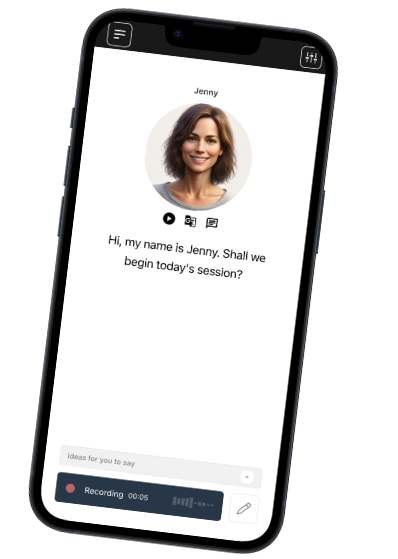
Talkio is the ultimate language training app that uses AI technology to help you improve your oral language skills!
Try Talkio