
Why You Can Read a Language but Still Cannot Speak It: The Output Gap Most Learners Ignore
Last updated on
Editorial owner: Kier Lee Zamora · Editorial policy
You can read a restaurant menu, follow subtitles, understand a grammar explanation, and still freeze when someone asks you a simple question. That does not mean you are “bad at languages.” It usually means you have trained input far more than output.
This is the output gap: the hidden distance between recognizing a language and producing it in real time. It is why learners can score well on vocabulary apps, read articles comfortably, and still panic when they need to say, “Actually, I disagree,” “Could you repeat that?” or “I’m looking for the train platform.”
Here is the slightly uncomfortable truth: reading and listening can make you knowledgeable, but they do not automatically make you speak. Near the end, you will find a 7-day “output gap reset” that forces your brain to convert passive knowledge into speech without needing a tutor, a flight abroad, or a perfectly quiet study routine.
The Output Gap: Why Recognition Feels Like Fluency Until You Open Your Mouth
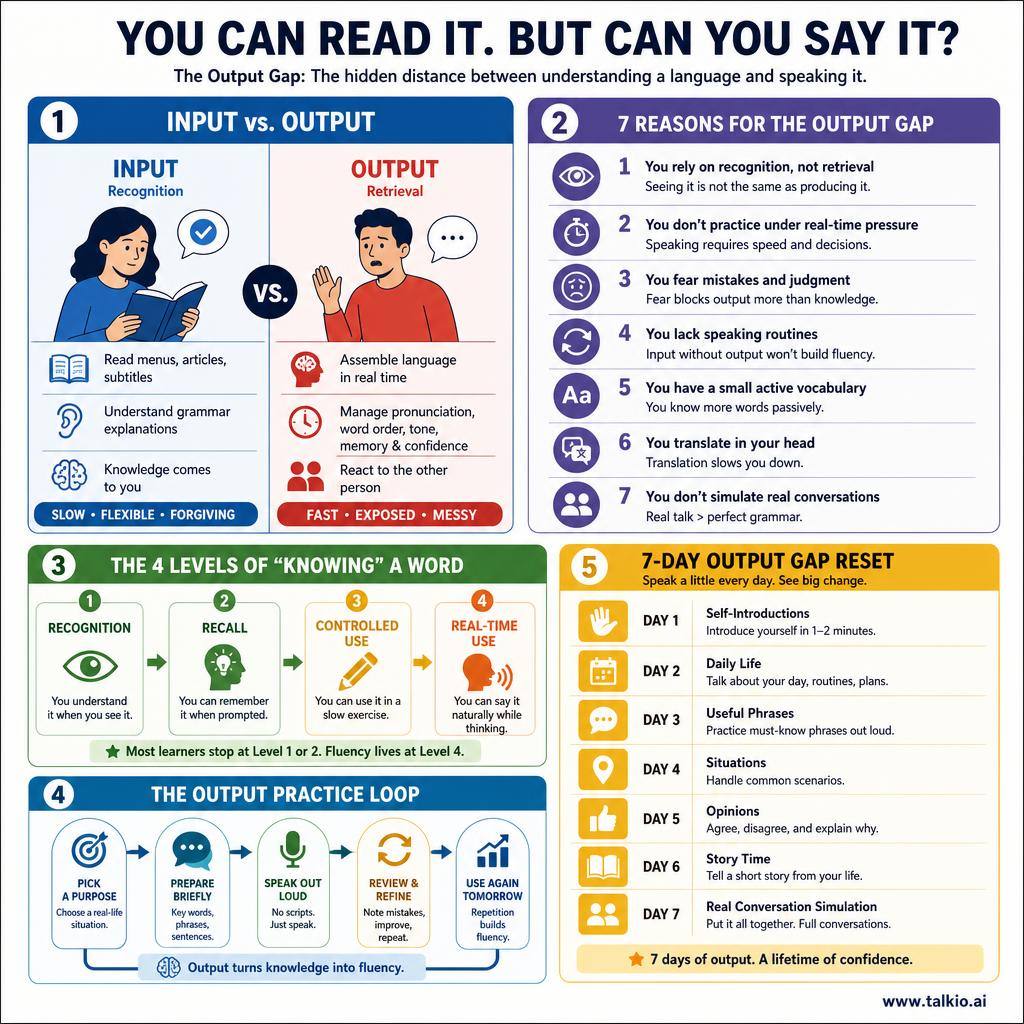
Reading is slow, flexible, and forgiving. Speaking is fast, exposed, and messy. When you read, the language comes to you already assembled. When you speak, you must assemble it yourself while managing pronunciation, word order, tone, memory, confidence, and the other person’s response.
That is a completely different skill stack.
Reading uses recognition. Speaking uses retrieval.
If you see the Spanish sentence “No estoy seguro de que sea una buena idea”, you may understand it: “I’m not sure it’s a good idea.” But can you produce it instantly in conversation?
Many learners cannot, because understanding a phrase and retrieving it under pressure are different mental tasks. Research on second language acquisition has long distinguished between input, interaction, and production. For broader academic reading, you can browse research indexed on ERIC or language learning studies on Google Scholar.
The “I know this word” illusion
You may “know” a word in four different ways:
- Recognition: You understand it when you see it.
- Recall: You can remember it when prompted.
- Controlled use: You can use it in a slow exercise.
- Real-time use: You can say it naturally while thinking about meaning.
Most learners confuse the first level with the fourth. That is why vocabulary size can feel impressive on paper but disappoint in conversation.
Seven Reasons You Can Read a Language but Still Cannot Speak It
The output gap is not one problem. It is a cluster of smaller bottlenecks. Fixing it starts with knowing which one is blocking you.
1. You have passive vocabulary, not active vocabulary
Passive vocabulary is language you understand. Active vocabulary is language you can produce. A learner may understand 5,000 words but comfortably use only 800 in speech. That is normal, but it becomes a problem when your study routine keeps adding new words instead of activating old ones.
Try this quick test:
- Choose 10 words you “know” from an article you recently read.
- Close the article.
- Use each word in a spoken sentence without writing first.
- Then use three of them in a 30-second story.
If that feels hard, your problem is not vocabulary knowledge. It is vocabulary access.
2. You learned grammar as explanation, not movement
Grammar explanations are useful, but speaking requires grammar to become automatic. If you have to mentally recite a rule before forming a sentence, conversation will outrun you.
For example, many English learners understand the difference between do, does, and did, but still hesitate when asking questions. That is why grammar needs to be practiced in spoken patterns, not just quizzes. Talkio has covered this problem in depth in why grammar quizzes may not improve real speaking.
3. Your mouth has not practiced the sounds
Reading does not train your tongue, lips, jaw, rhythm, or breath. You may know exactly what a word means and still struggle to pronounce it smoothly.
This is especially obvious with sounds that do not exist in your first language: English th, French nasal vowels, Spanish rolled r, German ch, Hindi retroflex consonants, or Mandarin tones. Pronunciation is physical, not just intellectual.
For sound-specific practice, compare your own struggles with examples from Talkio’s guides to training English “th” sounds and using minimal pairs like ship vs. sheep.
4. You are missing conversation formulas
Real speech is full of reusable chunks. Native and fluent speakers do not create every sentence from scratch. They rely on formulas such as:
- “What I mean is…”
- “That depends on…”
- “I see your point, but…”
- “Could you give me an example?”
- “I’m not sure how to explain it, but…”
- “Let me think for a second.”
If you only study individual words, you lack the ready-made bridges that keep conversation moving. This is one reason learners fall into awkward silence even when they know a lot. Talkio’s article on why first conversations fail explores this exact issue.
5. You have not trained speed
Reading gives you time. Speaking does not. Even slow conversations require fast decisions:
- Which tense fits?
- Which word is polite enough?
- How do I pronounce this?
- What did the other person just imply?
- How do I respond without sounding rude?
This is why learners often say, “I knew what I wanted to say, but it came too late.” Your knowledge exists, but your retrieval speed is not trained yet.
6. You avoid mistakes, so your brain avoids risk
Speaking involves public error. Reading does not. If your study routine rewards correctness and punishes experimentation, your brain learns to stay silent unless it can guarantee a perfect sentence.
That is deadly for fluency. Output improves through trial, feedback, repair, and repetition. If you need a mindset reset, read Talkio’s piece on why mistakes speed up fluency.
7. You practice language as content, not interaction
Reading an article about travel is not the same as asking a hotel receptionist for help. Watching a business English video is not the same as disagreeing politely in a meeting. Interaction adds pressure, timing, turn-taking, and social choices.
This is where many traditional routines fail: they prepare you to understand language, but not to use it with another “person” responding unpredictably.

Input Is Not the Enemy: The Problem Is Input Without Conversion
Do not stop reading. Do not stop listening. Input matters. Organizations such as the British Council and Cambridge English publish extensive work on language learning, assessment, and skills development, and input remains a major part of learning.
The problem is not input. The problem is input that never becomes output.
The conversion rule
For every useful thing you read or hear, convert part of it into speech. Not later. Not “when you feel ready.” Immediately.
Use this simple conversion pattern:
- Notice: Find one useful phrase in what you read or heard.
- Repeat: Say it out loud three times with natural rhythm.
- Change: Modify one part of the phrase.
- Personalize: Make it true for your life.
- Respond: Use it in a short answer to a realistic question.
Example: turning reading into speaking
Suppose you read this sentence in English:
“Many employees hesitate to speak up during meetings because they are afraid of making mistakes.”
Do not just understand it. Convert it:
- Repeat: “Many employees hesitate to speak up during meetings.”
- Change: “Many students hesitate to ask questions during class.”
- Personalize: “I sometimes hesitate to speak up when I’m not sure about my grammar.”
- Respond: “Why do people stay quiet in meetings?” → “I think many people hesitate because they don’t want to sound unprofessional.”
That one minute of output is more valuable for speaking than highlighting ten more sentences.
The Speaking Skills You Cannot Get From Reading Alone
Reading can feed your vocabulary and grammar, but it cannot fully train the performance side of speaking. These are the skills that require spoken practice.
| Speaking skill | Why reading alone does not train it | Practice example |
|---|---|---|
| Pronunciation | Your mouth must build muscle memory for unfamiliar sounds. | Repeat “three things” slowly, then faster, then inside a sentence. |
| Fluency | You need timed retrieval, not unlimited thinking time. | Answer “What did you do yesterday?” in 20 seconds. |
| Repair strategies | Reading does not teach you how to recover when stuck. | Use “Let me say that another way…” after a mistake. |
| Listening while planning | Conversation requires understanding and preparing a response at the same time. | Listen to a question, pause two seconds, then answer naturally. |
| Social tone | Written language often hides politeness, hesitation, humor, and emotion. | Practice direct vs. polite requests: “Send it” vs. “Could you send it when you have a chance?” |
These are also the skills that create the feeling of “real fluency.” If you are wondering how fluent you actually need to be, Talkio’s guide to what it means to speak a language fluently gives a practical breakdown.
Mini Drills That Turn Passive Knowledge Into Speech
You do not need two-hour speaking sessions to close the output gap. You need frequent, targeted retrieval. The drills below are short enough to fit into a normal day, but they force your brain to produce language instead of merely recognize it.
Drill 1: The 10-word activation sprint
- Choose 10 words from something you read.
- Say one sentence with each word.
- Say a second sentence that connects two of the words.
- End with a 45-second summary using at least five words.
Example words: appointment, delay, confirm, available, prefer, mistake, explain, improve, nervous, option.
Spoken challenge: “I need to confirm my appointment because there may be a delay. If another option is available, I would prefer the morning.”
Drill 2: The sentence flip
Take one sentence and force it through several forms. This trains grammar flexibility.
- Original: “I usually work from home.”
- Past: “I usually worked from home last year.”
- Negative: “I don’t usually work from home.”
- Question: “Do you usually work from home?”
- Opinion: “I prefer working from home because I can focus.”
- Problem: “The only problem is that I sometimes feel isolated.”
Drill 3: The “stuck phrase” rescue kit
Most learners do not need perfect grammar as much as they need recovery phrases. Memorize these in your target language:
- “How can I say this?”
- “I forgot the word, but it means…”
- “Let me try again.”
- “That’s not exactly what I meant.”
- “Can you ask the question in a different way?”
- “I understand, but I need a moment to answer.”
These phrases reduce panic because they give you a way to stay in the conversation while your brain searches for the right words.
Drill 4: The one-minute opinion
Choose a simple topic and speak for one minute. Do not stop. If you make a mistake, repair it and continue.
Topics:
- Is working from home better than working in an office?
- Should children learn a second language early?
- Is it better to travel alone or with friends?
- Do language apps help or distract learners?
- What is one habit you want to change this year?
Useful structure: “In my opinion… One reason is… For example… On the other hand… So I think…”
How AI Speaking Practice Helps Close the Gap
The output gap exists because learners do not speak enough, do not get enough feedback, and do not repeat the same useful situations often enough. AI conversation tools are not magic, but they solve a very practical problem: they make spoken practice available whenever you are ready to talk.
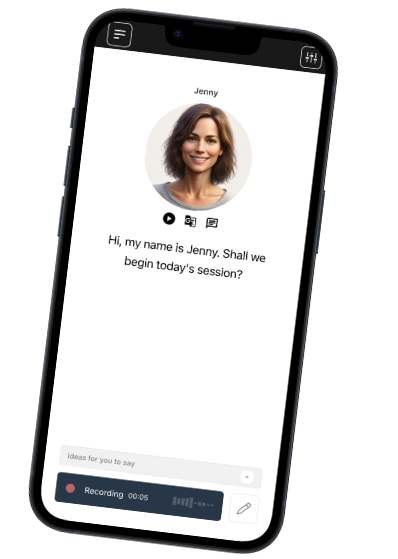
Talkio is designed around real-time voice interaction, which means learners can practice speaking with an AI tutor, receive feedback on pronunciation and sentence structure, and repeat role-play scenarios until the language becomes easier to retrieve.
Where AI is especially useful
- Low-pressure repetition: You can repeat the same scenario without feeling annoying.
- Instant feedback: You can notice pronunciation, fluency, and grammar issues immediately.
- Role-play practice: You can rehearse job interviews, travel problems, meetings, exams, or small talk.
- Dialect exposure: You can practice with different language varieties instead of assuming there is only one “correct” accent.
- Custom pacing: You can slow down, repeat, or increase difficulty as your confidence grows.
This is why AI conversation practice is becoming a serious alternative to passive app routines. For a broader comparison of tools, see Talkio’s guide to the best AI language speaking practice apps. If your main problem is practicing alone, this article on AI warm-ups for solo speaking practice gives a useful starting point.
Prompts you can use with an AI tutor
Try prompts like these when you want to convert passive knowledge into real speech:
- “Ask me five beginner questions about my weekend, then correct my answers.”
- “Role-play a hotel check-in and make one unexpected problem happen.”
- “Help me practice polite disagreement in a business meeting.”
- “Ask follow-up questions until I can answer without long pauses.”
- “Listen for pronunciation problems with the sound /r/ and give me short drills.”
- “Give me a B1-level conversation about travel, then summarize my mistakes.”
The key is to ask for interaction, not explanation. If your AI tutor only explains grammar, you are still mostly in input mode. Make it ask, interrupt, clarify, and respond.
The 7-Day Output Gap Reset
This is the promised reveal: you do not close the output gap by “studying harder.” You close it by changing the ratio. For seven days, keep your normal reading or listening habit, but attach a small speaking task to every input session.
Your checklist
- Day 1: Read and retell. Read a short text, then summarize it out loud in five sentences.
- Day 2: Steal five phrases. Choose five useful phrases and say a personalized version of each.
- Day 3: Record one minute. Speak about a familiar topic, listen back, and note one pronunciation issue.
- Day 4: Do a role-play. Practice a realistic situation: ordering food, joining a meeting, asking for help, or introducing yourself.
- Day 5: Practice repair. Intentionally start difficult sentences and use phrases like “Let me try again” when you get stuck.
- Day 6: Speed round. Answer 10 simple questions with only three seconds to start each answer.
- Day 7: Repeat the same scenario. Do one role-play three times and make the third version smoother, not more complex.
What to measure
Do not measure only minutes studied. Measure speaking behavior:
- How long can you speak before switching to your first language?
- How many pauses are caused by missing words?
- Can you repair a sentence after a mistake?
- Can you answer follow-up questions?
- Can you reuse phrases from yesterday?
- Are your sentences getting smoother, even if they are still simple?
This is more meaningful than a streak. Talkio has written about this exact issue in why streaks do not necessarily measure speaking level.
A Better Study Ratio: Read Less Passively, Speak More Deliberately
If you love reading in your target language, keep doing it. Reading builds vocabulary, grammar awareness, cultural knowledge, and motivation. But if your goal is speaking, reading must feed output.
A practical weekly ratio might look like this:
| Learner type | Input | Output | Best focus |
|---|---|---|---|
| Beginner | 70% | 30% | Short answers, pronunciation, survival phrases |
| Intermediate | 50% | 50% | Role-play, opinions, repair strategies, speed |
| Advanced | 40% | 60% | Nuance, persuasion, storytelling, professional scenarios |
For many intermediate learners, the problem is not lack of knowledge. It is that they keep consuming more language when they should be pressure-testing what they already know. That is one reason the fluency plateau feels so frustrating.
Use this rule after every input session
Before you close the book, app, podcast, or article, ask:
- What are three phrases I want to use?
- What is one opinion I can say about this topic?
- What question would someone ask me about it?
- Can I explain the main idea in 30 seconds?
- Can I say it again more naturally?
If you can answer those out loud, your reading is no longer passive. It becomes fuel for speaking.
The Real Goal: Not Perfect Speech, but Available Speech
The learners who improve fastest are not always the ones who know the most grammar. They are often the ones who can access simple language quickly, repair mistakes calmly, and keep talking when the sentence is not perfect.
That is the real target: available speech. Language that is ready when you need it.
So the next time you understand a paragraph but cannot discuss it, do not call yourself a failure. Call it what it is: unconverted input. Then convert it. Say it. Change it. Personalize it. Use it in a question. Use it in a role-play. Use it badly, then better.
Your reading knowledge is not wasted. It is raw material. Speaking begins when you stop collecting it and start forcing it into motion.
Talk Your Way
to Fluency
Talkio is the ultimate language training app that uses AI technology to help you improve your oral language skills!
Try Talkio