

Speak Faster With the 4-3-2 Fluency Drill
Last updated on
Editorial owner: Taylor Freeman · Editorial policy
You know the topic. You know the words. Then someone asks you to speak, and every sentence arrives late.
The usual response is to study more vocabulary. That can help, but it often misses the real problem. Your brain may already know enough words. It simply cannot retrieve and arrange them quickly while another person is waiting.
A deceptively simple exercise targets that delay: tell the same short story in four minutes, then three, then two. It is called the 4-3-2 speaking drill. Repeating yourself may sound like lazy practice. In fact, the time pressure can turn slow, effortful speech into language that is easier to access.
Here is the useful twist: the goal is not to cram the same number of words into less time. The goal is to say the important parts with fewer pauses, cleaner phrasing, and less mental searching.
What is the 4-3-2 speaking drill?
Choose one familiar topic and speak about it three times:
- Four minutes: tell the full story or explain the idea.
- Three minutes: repeat it to a new listener, keeping the strongest details.
- Two minutes: repeat it again, with a clear beginning, middle, and end.
The classic classroom version uses a different listener each time. That matters because you are not merely reciting into the air. You are communicating the same message to a fresh person. When no partner is available, an AI tutor can play the three listener roles and ask a different follow-up after each round.
Researcher Paul Nation described this kind of fluency practice in his work on improving speaking fluency. Later studies explored repeated speaking with shrinking time limits and found gains in speed and fluency, although accuracy and complexity do not always improve in exactly the same way. That nuance is important. This is a fluency drill, not a complete language course.

Why saying the same thing again feels easier
On the first attempt, your attention is split. You must decide what to say, find the words, build the grammar, pronounce the sentence, and watch the listener’s reaction. That is a heavy load.
On the second attempt, the message is no longer new. You have already made many of the hard content decisions. More attention becomes available for delivery. On the third attempt, useful phrases can begin to behave like ready-made units rather than puzzles assembled one word at a time.
This helps close the gap between understanding a language and producing it. It also explains why learning isolated words is not enough. Fluent speakers often rely on chunks such as “what surprised me was,” “the main reason is,” or “at first I thought.” If you want a deeper look at that idea, see Talkio’s guide to connected speech and natural phrasing.
A controlled study by Nivja de Jong and Charles Perfetti linked repeated speaking practice with changes in fluency and language access. You can read the study through its International Review of Applied Linguistics record. Another study by Chau Thai and Frank Boers tested repeated monologues under increasing time pressure. Its TESOL Quarterly record is a useful reminder that speed, accuracy, and complexity are related but separate outcomes.
The RACE framework: make repetition productive
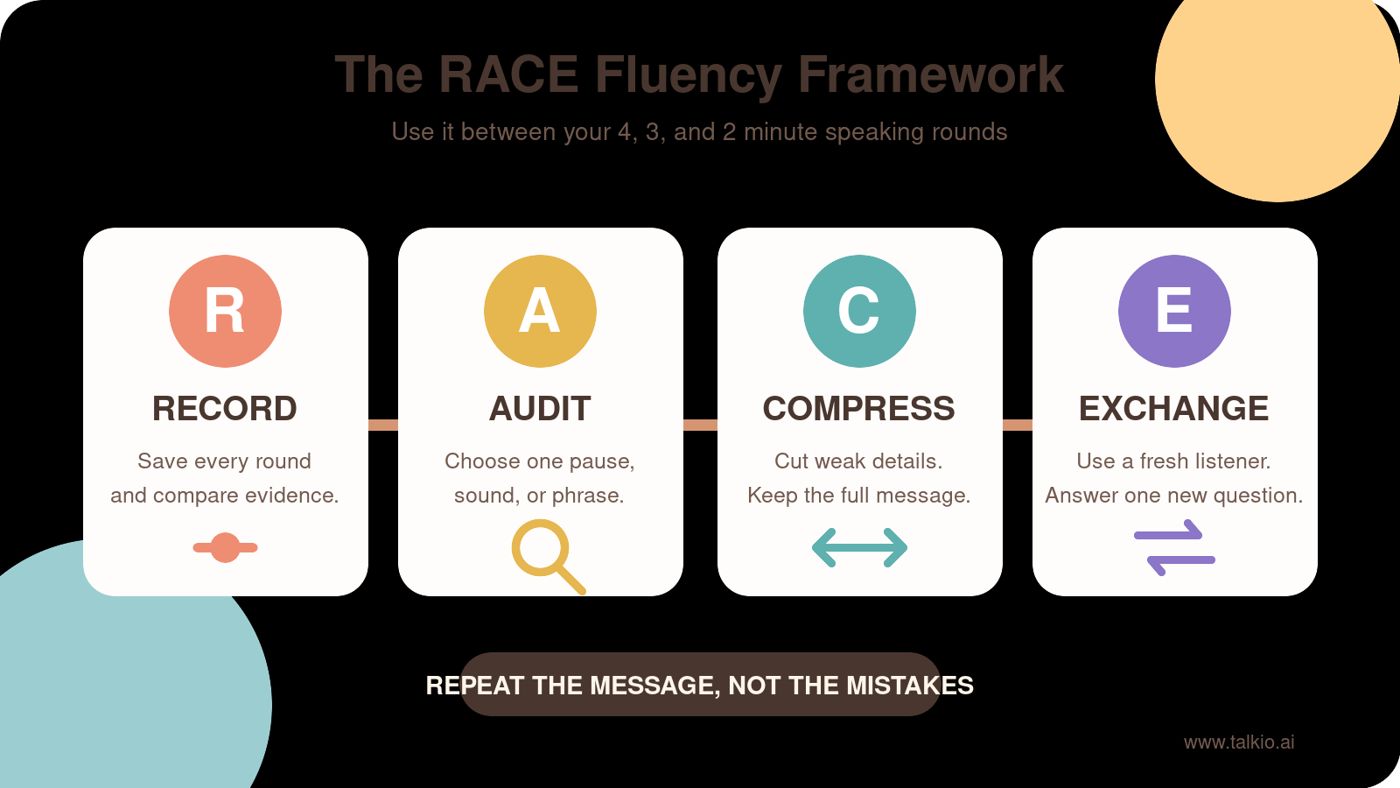
Mindless repetition can make mistakes feel familiar. Use the RACE framework to keep each round useful:
- R: Record. Save each attempt so you can compare real evidence, not memory.
- A: Audit one issue. Notice one repeated pause, unclear sound, or grammar problem.
- C: Compress. Remove side details while keeping the message complete.
- E: Exchange. Use a fresh listener or ask for a new follow-up question.
The audit must stay small. If you try to fix every error between rounds, the drill turns back into slow accuracy work. Pick one issue that blocks understanding. Leave minor mistakes for a separate review.
A practical 15-minute 4-3-2 session
You do not need special material. A timer, a recorder, and one speaking partner are enough. If you practise alone, use a voice recorder or follow these AI speaking warm-ups for solo learners.
- Pick a familiar topic for one minute. Good options include a recent meal, a difficult journey, a small workplace problem, or a film you enjoyed. Do not research first.
- Write five anchor words. Use keywords only. A full script changes the task into reading.
- Speak for four minutes. Keep going when a word is missing. Describe it, use a simpler word, or repair the sentence.
- Review for one minute. Listen to one short section. Choose one phrase to improve.
- Speak for three minutes. Tell the same story to a fresh listener. Use your improved phrase, but do not chase perfection.
- Review for one minute. Cut one weak detail and notice your longest pause.
- Speak for two minutes. Give the clearest version. Finish the message instead of racing the clock.
- Answer one unexpected question. This checks whether your speech is flexible rather than memorised.
That final question is essential. Without it, the exercise can become a polished monologue that falls apart as soon as a real conversation changes direction. It also prepares you for the awkward silence described in this guide to surviving your first real conversation.
Choose topics that transfer to real conversations
The best topic is not “my holiday” for the twentieth time. Choose something you are likely to explain soon:
- a short introduction for a networking event;
- a project update for a meeting;
- a problem at a hotel or airport;
- a reason for your opinion in a class discussion;
- a story you often tell friends;
- an explanation of a process you use at work.
Spanish learners might rehearse a restaurant problem or travel story using Talkio’s guide to Spanish speaking practice with AI. English learners can combine the drill with the American English speaking practice page. The language can change, but the structure stays the same.
Common mistakes that weaken the drill
- Writing a full script: you practise memory and reading instead of live retrieval.
- Speaking faster at any cost: rushed, unclear speech is not fluency.
- Changing the topic each round: the benefit comes from repeating the same message.
- Correcting everything: too much feedback breaks the flow and raises anxiety.
- Using only one listener forever: a new listener makes you communicate, not merely recite.
- Skipping the follow-up: real conversations are interactive.
If fear of errors keeps stopping you, read why mistakes can support faster progress. The drill should feel focused, not threatening.
How to tell whether it is working
Do not judge progress only by how confident you feel. Compare your recordings once a week and track a few simple signs:
- fewer silent pauses longer than two seconds;
- fewer abandoned sentences;
- more complete ideas before the timer ends;
- clearer use of linking phrases;
- an easier answer to the unexpected follow-up.
You can also note words per minute, but do not worship the number. A modest speed with clear phrasing is better than a fast stream that the listener cannot follow. If your speech becomes faster but less accurate, slow the final round to three minutes for a week and add a short correction step.
The 4-3-2 drill also works well beside shadowing, but the two exercises train different things. Shadowing builds listening, rhythm, and imitation. Retelling forces you to choose and retrieve your own language. That is why shadowing alone is not enough for many learners.
Your first topic is simpler than you think
Describe a moment from the last seven days when something did not go as planned. Use five anchor words. Tell it in four minutes, then three, then two. Record each round. Fix one issue. Finish with a question you did not prepare.
You may not learn a single new word during those ten minutes of speaking. That is precisely the point. Fluency is not only about adding more language. It is also about making the language you already know arrive on time.
Talk Your Way
to Fluency
Talkio is the ultimate language training app that uses AI technology to help you improve your oral language skills!
Try Talkio