As AI Translation Gets Better, Speaking Practice Matters More, Not Less
Last updated on
Editorial owner: Grzegorz Markowski · Editorial policy
AI translation keeps getting better, faster, and more convenient. That should mean fewer people care about speaking another language themselves. Instead, the opposite is happening. The easier translation gets, the more obvious it becomes that fluency is not just about decoding words. It is about timing, tone, trust, and the ability to think out loud with another human being.
That is the strange little twist of 2026. We are surrounded by smarter voice tools, real time captions, and multilingual assistants. At the same time, language learners are putting more energy into live speaking practice, not less. If that sounds backwards, it is not. It is actually a pretty rational response to what AI can do now, and what it still cannot do for you.
Talkio has already explored why instant translation is everywhere, yet speaking still matters. What is becoming clearer this year is the next step, learners are no longer practicing speaking just to survive basic conversations. They are practicing to sound natural when nuance matters, especially in interviews, meetings, travel, and relationships.
The 2026 shift, AI is everywhere, but confidence is still personal
Recent AI reporting has hammered home the same point, model quality keeps improving at a ridiculous pace, and adoption is happening faster than most people expected. MIT Technology Review’s coverage of the 2026 AI Index describes a market moving so quickly that benchmarks, policy, and the job market are all struggling to keep up. Google is also pushing AI deeper into education products and educator workflows, which means more learners will interact with AI as part of everyday study habits, not as some niche experiment.
So yes, learners will absolutely use AI to translate, summarize, and explain. They should. That is efficient. But efficient is not the same as fluent.
When you are in a real conversation, a lot happens in a few seconds. Someone changes direction mid sentence. They joke. They soften criticism. They say one thing politely while implying another. Translation can help you understand the words. It cannot fully build the reflexes you need to respond with calm, confidence, and personality.
That is why more serious learners are treating AI as a rehearsal partner, not a replacement for speaking. It is the same logic behind conversation rehearsal for high stakes talks. You do not practice because AI is weak. You practice because the human moment still belongs to you.
Translation solves access, not presence
This is where a lot of language learning content gets sloppy. It talks as if translation and speaking practice are enemies. They are not. Translation tools are useful. In some contexts, they are incredible. If you are navigating an airport, checking medical instructions, or reading a contract summary, that support matters.
The problem shows up when learners assume comprehension equals capability. It does not.
You can understand a translated sentence and still freeze when it is your turn to speak. You can know the right phrase and still sound hesitant because you have never used it in a live exchange. You can rely on AI for support and still miss the social rhythm of conversation, which is often where confidence either shows up or falls apart.
That gap between understanding and presence is exactly why speaking practice keeps winning. It is not old fashioned. It is adaptive.
Why this matters more now, not less
There are three reasons this topic is getting more urgent in 2026.
First, AI voice experiences are becoming normal. More people are speaking to machines out loud, which lowers the barrier to practicing a language verbally. That is a huge behavioral shift. A learner who would never book a tutor or join a language exchange can still open an app and start talking.
Second, multilingual work is getting messier. More global teams now have captioning, transcription, and translation inside meetings, but that does not remove the career upside of being able to speak directly. In fact, it often highlights it. If everyone can get the rough meaning, the person who can build rapport without friction stands out even more. That lines up with Talkio’s recent point about auto translated meetings still not replacing human speaking ability.
Third, learners are getting smarter about what they want from AI. The novelty phase is ending. People are asking more practical questions now. Not, “Can AI talk to me?” but, “Can AI help me sound more natural in the exact situations I care about?” That is a much better question, and it leads directly to scenario based speaking practice.
The new goal is not perfect grammar, it is recoverable speech
One of the most useful mindset shifts for learners is dropping the fantasy of perfect speaking. Real fluency is not flawless. It is recoverable. You hesitate, then keep going. You misunderstand, then repair. You search for a word, then rephrase without panicking.
That kind of skill is hard to build with passive study alone. It comes from repeated live practice in low stakes settings. That is why learners who already understand a lot of grammar still get stuck when the conversation starts. They trained for correctness, not for momentum.
Talkio is well positioned here because the product is built around actual conversation flow. It is not trying to trap learners in endless drills. It is trying to help them practice speaking in a way that feels like reality, minus the social risk that makes many people shut down. That also connects with the broader argument in why AI conversation partners are replacing language exchange apps in 2026. Consistency beats chaos.
How to use AI translation without letting it weaken your speaking
If you want the best of both worlds, use translation as a scaffold, not a crutch.
Start by translating before or after a conversation, not during every sentence. Use it to prepare vocabulary for a specific scenario, like a team meeting, an apartment viewing, or a doctor visit. Then switch into speaking mode and stay there long enough to struggle a little. That struggle is not a bug, it is the training effect.
You can also use AI to review your performance after practice. Ask for clearer phrasing, more natural alternatives, or a simpler way to say what you meant. That turns AI into a coach instead of a permanent mouthpiece.
If you want a practical structure, try this:
- Pick one real world scenario you care about.
- Use translation or AI support to collect useful phrases.
- Practice the conversation aloud without reading.
- Repeat with small variations until your responses feel less scripted.
- Review your weak spots after the session, not every five seconds during it.
This works because it matches how actual confidence is built. Not through perfect preparation, but through repeated recovery in context.
Where language learners can win in an AI heavy world
The internet is full of dramatic takes about AI making language learning obsolete. Honestly, that is lazy thinking. AI is changing language learning, sure, but mostly by raising the bar for what counts as valuable human skill.
Basic decoding is becoming cheaper. Generic phrasing is becoming easier. Surface level understanding is becoming automated. The learner advantage is shifting toward areas that still feel deeply human, tone, persuasion, warmth, humor, and the ability to adapt in real time.
That is good news if you care about actual communication. It means the future does not belong to the person who memorized the most flashcards. It belongs to the person who can enter a conversation, stay calm, and connect.
That is also why this is a strong content angle right now. It rides the AI wave without repeating the same tired “AI will replace teachers” garbage. It gives learners a more interesting story, use the new tools, but train the part of communication that still matters most.
The bottom line
As translation gets better, speaking becomes more valuable, not less. Not because translation is failing, but because it is exposing what fluency really is. Fluency is not access to meaning. It is the ability to show up in real time with clarity, confidence, and your own voice.
That is the opportunity for language learners in 2026. Let AI handle support. Let it lower the friction. Let it help you prepare. But do not outsource the one skill that makes conversations feel human. Practice that part on purpose.
If you want to build that muscle, the best move is simple, rehearse the conversations you actually expect to have. That is where tools like Talkio can help, not by pretending speaking no longer matters, but by giving you a smarter place to practice it.
If you want a practical starting point, begin with a simple speaking warm up routine. Then build toward the moments that matter most.
External sources: MIT Technology Review on the 2026 AI Index, Google on new AI tools for educators and learners, Stanford HAI AI Index, World Economic Forum on AI and changing work.
Talk Your Way
to Fluency
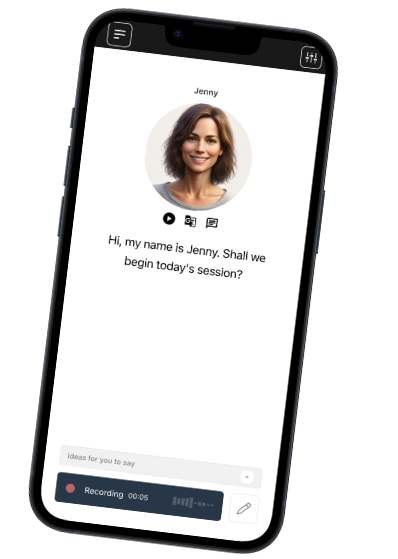
Talkio is the ultimate language training app that uses AI technology to help you improve your oral language skills!
Try Talkio